
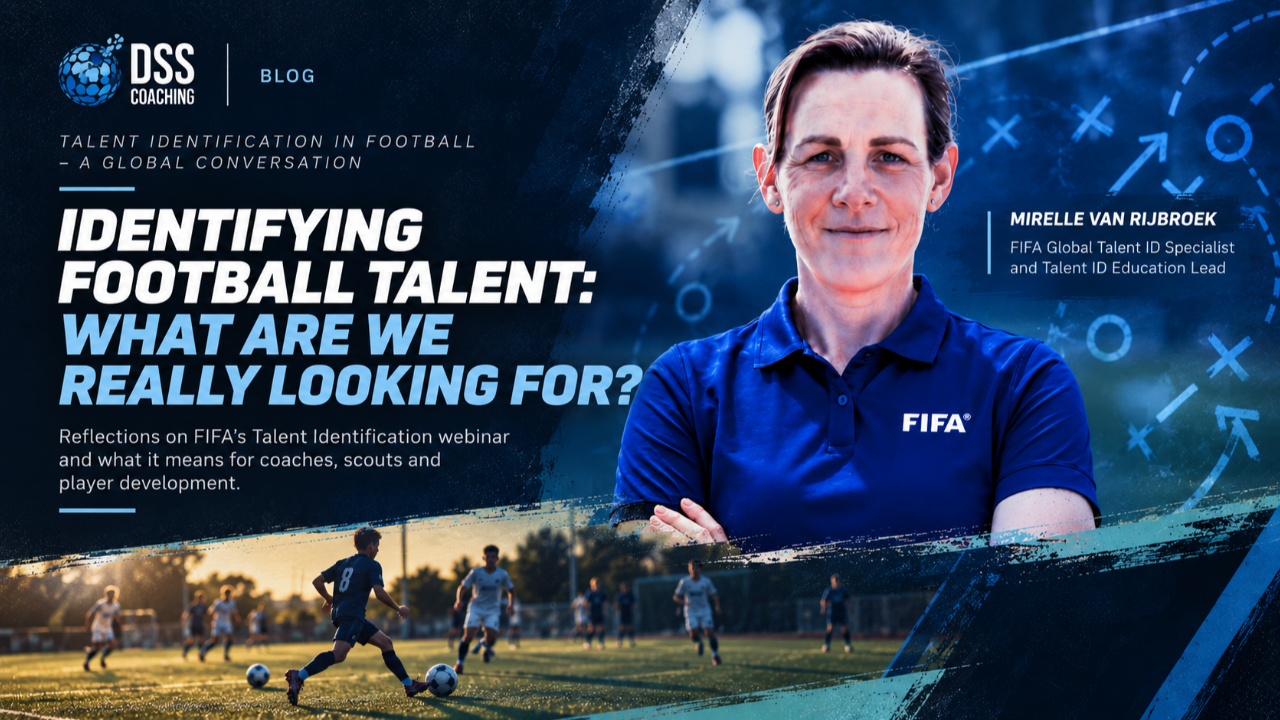
Identifying football talent: what are we really looking for? By Ciaran Deely PhD
Oct 07, 2026Identifying football talent: what are we really looking for?
By Ciaran Deely PhD | DSS Coaching
I’ve spent a lot of my sporting life looking at players from different perspectives. First and foremost, I was a player myself, including playing senior inter-county Gaelic football with Wexford. Coaching eventually took over and I went on to manage the London senior Gaelic football team, while professionally much of my work moved into sport science, S&C and physical performance. That included working in professional football with Kerala Blasters, QPR Boys Academy and the QPR First Team, and eventually completing my PhD through QPR Academy.
More recently, another part of that journey has been developing myself more as a football coach. I completed my UEFA B earlier this year and am currently coaching within the QPR Girls Academy. That experience has probably made me increasingly interested in another part of player development: how we actually identify talent in the first place.
I’ve completed the FA Introduction to Talent Identification and, more recently, the FA National Talent ID & Scouting qualification. A couple of weeks ago, I added another piece of learning by joining the first webinar in FIFA’s new three-part Talent Identification series.
The session, Identifying Football Talent: What Are We Really Looking For?, was led by Mirelle van Rijbroek, FIFA’s Global Talent ID Specialist and Talent ID Education Lead, alongside Irish coach Lisa Fallon, FIFA Technical Expert. After a fairly rollercoaster few weeks following the Irish football team, it was good to see some Irish involvement in there too!
The central question was a simple but important one: when we identify a talented young footballer, are we identifying the player who is performing best today or trying to recognise the player with the greatest potential for tomorrow?
That question is particularly relevant to me now that I’m coaching young academy players. At 13 or 14 years of age, what we're seeing is really only a snapshot. Players are at different stages physically, technically, tactically and psychologically. They’ve had different coaching experiences and different opportunities, and some will inevitably develop much earlier than others.
The player dominating games today may well become an outstanding senior player. But they might not. Equally, the smaller or less influential player who shows occasional glimpses of something interesting might look completely different three or four years down the line.
That uncertainty is part of what makes Talent ID so interesting.
Looking at what the player actually does
One part of the webinar I particularly enjoyed was the discussion around the Football Action Cycle and becoming more precise about what we actually observe.
Rather than simply describing somebody as having “good technique”, “good awareness” or “good decision-making”, we can look at how the player perceives and communicates within the situation, what they decide to do, how they execute the action and then how they adapt to what happens next.
That thinking has been influenced by Raymond Verheijen’s work through Football Coach Evolution and by the KNVB methodology. His wider ideas around analysing football, football actions, communication, decision-making, execution and football fitness are interesting in their own right, and probably deserve a separate blog rather than trying to cover them properly here.
What I like about the approach from a Talent ID perspective is that it brings you back to the game itself. If I say a young midfielder is an excellent passer, for example, I should probably be able to explain what I mean. What information did they take in before receiving? Did they recognise the opportunity? Was the decision appropriate? Could they execute it under pressure?
That gives us a much richer picture of the player.
Identification is only the beginning
The other thought I came away with is how closely Talent ID and player development are connected.
We can spend a huge amount of time trying to identify the most talented 13-year-old, but that is only the start of their journey. The coaching they subsequently receive, the environment they enter, their physical development, the opportunities they are given and how we support them through the inevitable ups and downs will have an enormous influence on the player who eventually emerges.
That also means Talent ID isn’t only relevant to scouts. As coaches, we’re constantly making judgements about players. Who needs more challenge? Who needs more patience? What is actually limiting this player? Are we judging what they are now or considering what they could become?
I’m looking forward to completing the remaining FIFA webinars and then undertaking the new FIFA Talent Identification Foundation Programme. Alongside the FA Talent ID qualifications and my ongoing coaching development, it’s another area I want to keep exploring.
After coming at player development over the years as a player, coach, manager, sport scientist and researcher, Talent ID feels like another useful lens through which to understand the player in front of me.
------------------------------------------------------------
About DSS Coaching
DSS Coaching supports Gaelic Football and Hurling coaches through practical, evidence informed content. Membership includes weekly video breakdowns, coaching resources, CPD webinars, reflective tools, and access to a growing community of coaches.
You can find out more or join the DSS Coaching membership at: https://www.dsscoaching.ie/platform-membership
Got a Question?
Contact us for more information on DSS Coaching.
