
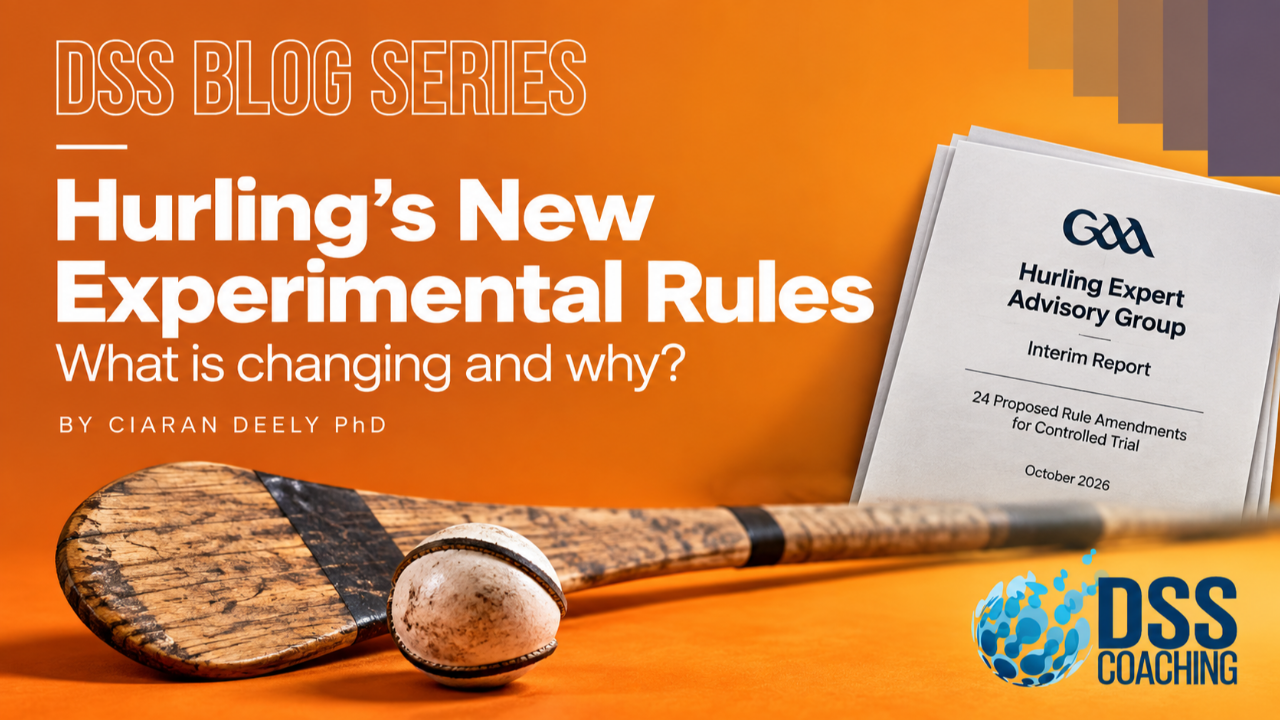
Hurling’s new experimental rules – what is changing and why?
Sep 10, 2026By Ciaran Deely | DSS Coaching
The GAA’s Hurling Expert Advisory Group (HEAG) has published its Interim Report, with 24 amendments to the playing rules moving into a controlled trial during the Electric Ireland Fitzgibbon Cup League from mid-October 2026. These are experimental rules rather than permanent changes, and HEAG Chair John Meyler has stressed that hurling remains in a very healthy position and probably requires only “one or two tweaks”, rather than a radical overhaul. The purpose is to identify whether relatively small changes can protect and enhance the characteristics that make hurling such a distinctive game.
Who is behind the review?
The Hurling Expert Advisory Group is chaired by former Cork senior manager John Meyler and brings together experience from playing, coaching, management, refereeing, administration and performance analysis:
- John Meyler – Chair
- Willie Maher – Secretary / GAA National Head of Hurling
- Richie Hogan – former Kilkenny hurler
- Ursula Jacob – former Wexford camogie player
- Jeff Lynskey – Galway coach and former All-Ireland winning underage manager
- Rory Hanniffy – former Offaly hurler
- John Keenan – former All-Ireland senior hurling final referee
- Terry Reilly – Chair of the Hurling Development Committee
- Dr Michael McKay – Games Intelligence Unit
The review has also been supported by the GAA Games Intelligence Unit (GIU), analysing trends around handpasses, rucks, puck-outs, fouls, possession and officiating. The consultation process included focus groups and approximately 8,500 survey responses, giving the group a substantial evidence base from which to consider possible changes.
Why are changes being considered?
- The growth of the handpass – Meyler highlighted approximately 135 handpasses in the 2026 All-Ireland Final. The concern is whether repeated handpassing, including questionable striking actions, is gradually reducing the amount of actual striking in the game.
- Rucks, tackling and congestion – The physical intensity of modern hurling has produced more multi-player tackles and situations where the ball carrier becomes tied up. Some of the changes are designed to create greater freedom for the player in possession while clarifying what constitutes a legal tackle.
- Restarts and possession – Short puck-outs have become increasingly sophisticated as a method of retaining possession. The group is examining whether longer puck-outs and positional restrictions can create more genuine contests for the ball.
The 24 amendments – six areas of change
(i) Handpassing and carrying the ball
(ii) Tackling and player protection
(iii) Throw-ins and restarts
(iv) Puck-outs and possession
(v) Scoring, advantage and goalscoring opportunities
(vi) Team communication and officiating
Several of the 24 amendments are technical clauses required to implement a broader rule change, so it makes more sense to view them as a package of changes across these six areas rather than 24 completely separate ideas.
(i) Handpassing and carrying the ball
- No consecutive handpasses
A player who receives the sliotar directly from a teammate's handpass cannot immediately handpass it again. The ball must be played by another method before another handpass can occur. This could be one of the most tactically significant changes, with the intention of reducing chains of handpasses and encouraging greater use of the hurley when teams play through pressure.
- A clear and definite handpass
The wording of the handpass rule is being strengthened. Rather than simply requiring a striking action, the player must make a “clear and definite” striking action with the hand. The responsibility therefore shifts towards the player to make the legality of the handpass obvious, directly addressing the controversial throw-ball that has increasingly become part of discussions around modern hurling.
- Six steps instead of four
Players will be permitted to carry the sliotar in the hand for a maximum of six consecutive steps rather than four. This acknowledges the reality of the modern game, where the four-step rule can be extremely difficult to judge consistently at full speed, although the challenge will be ensuring that six steps does not gradually become eight or ten in practice.
(ii) Tackling and player protection
- Holding the player with the arm
The definition of the tackle is being tightened. A player will not be permitted to tie up or hold an opponent using the arm, extending the existing restrictions around holding with the hand. This is aimed at reducing situations where the ball carrier becomes trapped by defenders and could place greater emphasis on defensive footwork, positioning, timing and legal shoulder contact.
(iii) Throw-ins and restarts
- One player from each team at the throw-in
At the start of each half, the throw-in would be contested by one player from each team rather than the traditional group of midfielders. The other designated midfield players would stand on opposite sidelines at halfway, while the remaining players must remain behind their respective 45-metre lines, creating a cleaner and more identifiable contest for the opening possession.
- Ground strike required at the throw-in
The two players contesting the throw-in must attempt to play the sliotar with a ground stroke, with failure to do so potentially resulting in a free. The same principle applies to other throw-ins, where the remaining players must remain 13 metres away, with the emphasis on encouraging a recognisable hurling skill rather than immediately creating another physical scramble.
(iv) Puck-outs and possession
- Puck-outs must travel beyond the 45
A puck-out must travel beyond the team's 45-metre line before it can be played by the defending team, effectively removing the conventional short puck-out to a corner-back or full-back. The intention appears to be to create more contests for possession and prevent teams simply retaining the sliotar uncontested from restarts.
- Player positioning at puck-outs
A minimum of three players from each team must remain between the 20-metre and 45-metre lines. This is designed to prevent everybody simply moving towards midfield once the short puck-out disappears, and the interaction between these two puck-out rules could significantly influence how teams structure their half-back, midfield and half-forward lines.
- Puck-out only after the referee's whistle
Goalkeepers will have to wait for the referee's whistle before restarting play. This removes some of the ultra-quick puck-outs that currently occur before the opposition has reset and should also make enforcement of the new positional requirements more manageable.
(v) Scoring, advantage and goalscoring opportunities
- The 65 becomes a much longer strike
A 65 will no longer be struck from the 65-metre line in the attacking half. Instead, it will be taken from the 65-metre line nearest the taker's own goal. This changes it from a relatively routine scoring opportunity for elite free-takers into a genuine long-range striking challenge and may encourage teams to develop alternative restart strategies.
- Two points for a sideline cut
A clean sideline cut that goes directly over the crossbar will be worth two points, provided no attacking teammate touches the sliotar. The sideline cut is one of hurling's most distinctive technical skills, and increasing its value could make specialist sideline striking a much more important element of individual and team preparation.
- Expanded advantage rule
If another foul occurs against the team receiving advantage during the five-second advantage period, the team can ultimately receive the free from the location of the original foul or a subsequent foul. The referee can also extend the advantage period where necessary to allow a scoring attempt already underway to be completed.
- Attacking team infringements during advantage
If the team receiving advantage subsequently commits an infringement during the advantage period, the original advantage is not automatically lost. The referee can return to the initial foul while dealing separately with the subsequent infringement, helping to ensure that the advantage rule genuinely benefits the team that was originally fouled.
- Denial of a goalscoring opportunity – body collision
The definition of cynical fouling when denying a goalscoring opportunity is being expanded to include deliberately colliding with an opponent after the player has released the sliotar, particularly where the intention is to prevent that player continuing into the attack.
- Denial of a goalscoring opportunity – jersey pull
A deliberate jersey pull used to deny a goalscoring opportunity is explicitly included within the revised definition.
- Denial of a goalscoring opportunity – holding the runner
Deliberately preventing or restricting an opponent from continuing their run after playing the ball, including holding or attempting to hold them, is also incorporated. These changes are particularly relevant to a player who releases the sliotar and then attempts to continue forward for a return pass.
- Yellow or red card rather than black card
For these cynical goalscoring-opportunity offences, the sanction would be a yellow or red card rather than a black card, creating a disciplinary framework more specifically suited to hurling.
(vi) Team communication and officiating
- Return of the maor foirne
Each team will again be permitted a maor foirne, who may enter the playing field during breaks in play to communicate with players. For coaches, this restores an opportunity to communicate tactical information directly during games, while entering the pitch outside the permitted periods would remain unauthorised.
- Greater powers for line umpires
Line umpires will take on a more active role in assisting the referee rather than concentrating predominantly on decisions involving the sideline.
- Line umpires assigned to halves of the pitch
Each line umpire will operate primarily within one half of the playing field, providing another viewing angle and additional support for the referee.
- Reporting foul play
Line umpires will have explicit responsibility for bringing instances of foul play to the referee's attention, including incidents occurring away from the ball.
- Wider match-officiating support
Taken together, these changes are intended to create a more collaborative officiating structure. At the speed at which modern hurling is played, expecting one referee to see every technical offence, tackle and off-the-ball incident is increasingly difficult.
- Revised restart structures
A number of the technical clauses within the 24 amendments relate to how the new throw-in and puck-out structures are administered, including player positioning and when the ball becomes playable. These may appear administrative but are required if the larger experimental concepts are to work consistently.
- Revised technical and disciplinary definitions
The final group of technical amendments involves the wording required to incorporate the revised handpass, tackle, advantage and goalscoring-opportunity offences into the existing playing rules. This is why the figure of 24 should not necessarily be interpreted as 24 completely independent innovations.
What happens next?
The rules will initially be trialled in the Electric Ireland Fitzgibbon Cup League from mid-October 2026 rather than across club or senior inter-county hurling. The Games Intelligence Unit will analyse the matches alongside feedback from players, coaches and referees before the HEAG makes further recommendations. Trialling does not mean adoption, and any permanent changes would still have to progress through the GAA's rules and governance structures.
DSS Coaching view – what should coaches watch?
There are some interesting ideas here and I think trialling them is worthwhile, but I would be cautious about making too many changes to a game that is fundamentally in a very good place.
On the 65, I like the idea of moving it back, as they have potentially become too easy to score in recent years, particularly with the changes to the sliotar. I would actually have it taken from the halfway line. That could also allow us to remove the 65-metre lines altogether and simplify the number of markings on the pitch. An interesting point was made in our DSS Coaching WhatsApp Community, though: not all pitches are the same length, so a halfway-line ‘65’ could be a very different proposition in Croke Park compared with Wexford Park. Although, as anyone who has played there will tell you, it’s always harder in Wexford Park... especially against the wind! 😉
I think the proposal that puck-outs must travel beyond the 45-metre line is worth trying. I don't necessarily see it creating the mayhem or congestion that some might expect. A hurling pitch is a big space and goalkeepers are technically good enough to pick out different areas and players beyond the 45, so it will be interesting to see what new puck-out strategies coaches develop around it.
I am less convinced by increasing the number of permitted steps from four to six. I would prefer to see the existing four-step rule enforced more consistently rather than changing it. Allowing six could easily result in players regularly taking seven, eight or more, which could move the game further towards carrying rather than striking.
The two-point reward for a successful sideline cut is a good initiative. It rewards one of the great traditional skills of hurling and could encourage players and coaches to spend more time developing it.
The return of the maor foirne is also worth looking at. There is value in allowing coaches to communicate with players during appropriate breaks in play, but the boundaries need to be very clear. We don't want to return to situations where the maor foirne becomes involved in the play or, worse again, becomes involved with opposition players.
The restriction on consecutive handpasses feels a little drastic to me. I would prefer the focus to be on properly enforcing what constitutes a legal handpass in the first place, because the amount of throwing that has crept into the game has become ridiculous. Tightening the requirement for a clear and definite strike would be a better starting point, and I also like the concept of encouraging players to handpass the sliotar directly off the hurley.
Overall, I would favour relatively small adjustments rather than major intervention. Tighten up the handpass, enforce the steps rule properly, reward skills such as the sideline cut and experiment with restarts. The Fitzgibbon League trials should give us a much better idea of which changes genuinely improve the game and which ones are better left alone.
