
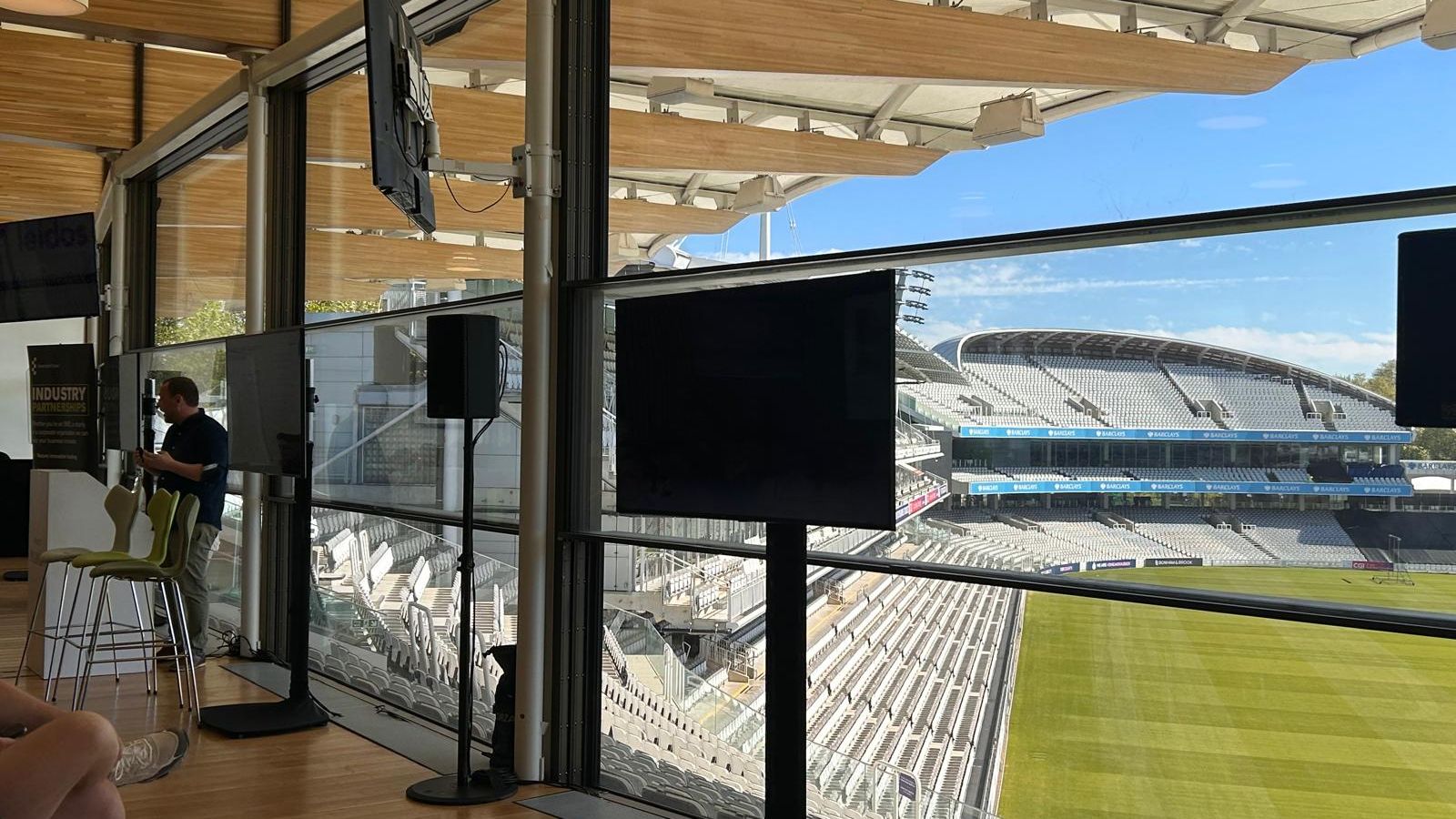
'Innovation in Sport' conference at Lord’s Cricket, London – Notes from the day
Apr 29, 2026Last Friday I was at the Innovation in Sport conference at Lord's Cricket Ground, organised by Dr. Jamie Tallent and the team at University of Essex School of Sport, Rehabilitation and Exercise Sciences.
It was a short event, but there was a good mix of speakers from cricket, football, academia, and applied performance environments. What I liked about it was that it stayed close to practice. There wasn’t much that felt overly theoretical or detached from the realities of working in sport.
Below is more a set of notes and reflections from the day rather than a polished summary.
Opening and Context
The day was hosted by Beth Shriever, who set the tone well, followed by opening remarks from Jamie Tallent around the importance of collaboration between academia and industry.
That theme ran through the entire event.
Middlesex Cricket – Bat Speed Project
The first main section was an “in conversation” with Middlesex County Cricket Club, with James Fleming alongside PhD researchers Ffion Jones and Tom Brazier.
Tom outlined a four-step model around bat speed that was simple but effective:
- establishing validity, sensitivity and reliability
- building benchmarks and normative data
- identifying the determinants of bat speed
- implementing training programmes
It was a good example of a structured approach that could be applied across sports, not just cricket.
Ffion spoke about her experience working within the club as a researcher. Learning a new sport, collaborating with practitioners, and developing new skills such as R coding all came up. It was a useful reminder of the challenge of bridging research and practice, and how important support from both sides is.
Football Case Study – Applied Practice
The football case study included work from QPR, presented by Ross Bennett alongside Albie Sayer.
Ross outlined three key areas within their approach:
- embedding research within the environment
- player profiling and Individual Development Plans
- linking physical performance to recruitment
There was also discussion around their Game Speed Model, the physical KPIs they track, and the testing that underpins it.
What stood out was not just the work itself, but the challenge of making it usable. Translating complex data into something that a coach or recruitment team can actually act on is not straightforward.
Albie spoke about what he described as a “one process journey”, which included:
- understanding how physical qualities change across the pathway
- tracking longitudinal development
- linking those qualities to match performance
- integrating the findings back into academy practice
That third step, linking testing to performance, is probably the most important.
Category 1 Academy Perspective
There was also input from a Category 1 Premier League academy Head of Physical Performance, who spoke about identifying performance problems and then attempting to close the research gap.
The key message here was around process.
Starting with the game model, understanding the demands of the game, identifying key moments, and then linking physical qualities to those moments. There was also a focus on robustness, repeatability of high-intensity actions, and the ability to recover.
It reinforced the idea that everything should be anchored back to what actually happens in the game.
Knowledge Transfer and Innovation
Robert Schatten spoke about Knowledge Transfer Partnerships (KTPs) and how they can be used to connect academic research with real-world problems.
The emphasis was on translating research into practical outcomes, with both longer-term projects and shorter, more flexible funding opportunities available.
There was also a section from Dr Louis Howe and Dr Zainab Altai on predictive biomechanics and their work through a KTP, showing how these partnerships can support innovation within industry settings.
Keynote – Benjamin Rosenblatt from 292 Performance
The keynote from Benjamin Rosenblatt was built around a series of real-world examples from Olympic and international sport.
A few that stood out:
- using blood flow restriction in elite athletes and managing the uncertainty that comes with new approaches
- attempting to turn a team bus into a recovery environment during tournament football
- monitoring neuromuscular status daily during Olympic competition and seeing very different individual responses
- addressing behaviour and culture rather than just physical preparation
The common thread across all of them was problem solving.
He also spoke about barriers to innovation, which he grouped into three areas:
- environment (lack of time and space)
- politics (lack of buy-in)
- culture (behaviours that don’t support change)
It was a useful way of framing challenges that most practitioners will recognise.
Final Thoughts
There was a short panel discussion to finish, which touched on topics like player buy-in, the use of technology, and the role of AI. The general message around AI was that it can be useful for efficiency, but still needs to be challenged and used carefully.
Looking back on the day, the main takeaway for me is that innovation in sport is not really about new tools or ideas.
It’s about clearly identifying a problem and working through a process to solve it.
That sounds simple, but it requires time, clarity, and the right environment.
And those are often the hardest things to create.
Yours in sport,
Ciaran
